

The 15 violin & viola bow strokes: How well do you really know them?
TECHNIQUE
7 min read
Knowing the names is one thing.
Knowing how to break them down clearly for yourself or your students is the real challenge.
Let’s review all 15 bow techniques, organized into 3 categories and presented in the order I would teach them:
Foundational / On-the-string strokes: These are the strokes I would teach first because they build tone, bow control, smooth changes, and basic articulation.
Advanced / Off-the-string strokes: This category moves from foundational control into short strokes with bounce, rebound, and speed.
Tone color & special effects: Bowing is not only about articulation, but also about color, character, and imagination.
The 15 bow strokes:
How well do you really know them?
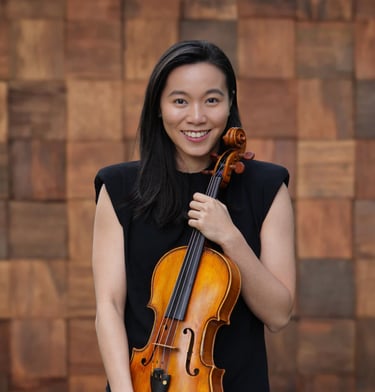
I’m Joyce—musician, violist, and lifelong learner. Here, I share teaching ideas and practical resources to help violinists, violists, and music educators teach, practice, and grow with clarity and confidence.
On-the-string
Détaché
Legato
Tenuto
Portato
Martelé
Tremolo
Tone color & Special Effects
Sul tasto
Sul ponticello
Retake
Col legno
Off-the-string
Collé
Staccato
Spiccato
Sautillé
Ricochet
Up-bow Staccato
Détaché = Pull - push - repeat
Legato = Glue - smooth - sing
Tenuto = Lean - sustain - release
Portato = Glide - press - glide
Martelé = Bite - release - draw
Tremolo = Light - quick - shimmer
Collé = Set - pinch - release
Tiny finger actions (lower half to middle)
Staccato = Catch - stop - release
Short separated notes
Spiccato = Drop - bounce - lift
Short separated notes with bounce (balance point)
Sautillé = Light - brush - fast
Stick feels off but hair is on (slightly above balance pt.)
Ricochet = Drop - let go/bounce - move
Up-bow staccato = Grip - release - travel
Sul tasto = Play near fingerboard
Sul ponticello = Play near bridge
Col legno = Turn - tap - rebound
Turn stick toward bridge, hair toward fingerboard
Cue words
TEACHING TIPS

Decoding the Dots
Détaché
The name is highly misleading to beginners. "Detached" makes students think the notes should sound short or separated. In reality, it just means the notes are unslurred (not attached to each other by the same bow stroke). A great détaché is actually incredibly smooth and connected!
Legato
Legato is secretly a left-hand technique masquerading as a right-hand technique. No matter how smooth your bow arm is, if your left-hand fingers drop onto the fingerboard sluggishly, the legato is ruined. The bow provides the "breath," but the fingers provide the clarity.
Tenuto
It’s not just about length; it's about gravity. To play tenuto properly, string players have to imagine the weight of their arm sinking into the string all the way to the very end of the note, fighting the natural tendency to let the sound decay.
Portato
This is essentially the bowing equivalent of a singer taking a deep breath and pulsing their diaphragm. You aren't stopping the bow; you are just leaning right-hand weight into the stick at specific intervals.
Martelé
Just like a piano hammer hits a string and immediately bounces off so the string can ring, the energy of martelé happens before the sound. You "bite" the string with heavy pressure, pull, and instantly release the pressure so the string can ring freely.
Tremolo
If you try to shake your whole arm to play tremolo, you will physically gas out in ten seconds. The secret is that the arm stays almost completely still; the "trembling" is entirely a loose, passive wagging of the right wrist and fingers.
TEACHING TIPS
Collé
Though the French word collé literally translates to "glued," it surprisingly describes a snappy, popping bow stroke. The counterintuitive name actually refers to the split-second before the sound begins, where the bow hair must heavily grip—or "glue"—itself to the string using just the weight and pinch of the right-hand fingers, before instantly releasing so the bow springs away.
Interestingly, pure collé is almost never used as a standalone stroke in actual performance repertoire; rather, it serves as the invisible "engine" of string playing. The tiny, flicking knuckle motions required to execute it act as a hidden spark plug that powers other techniques—initiating a crisp spiccato bounce, adding bite to fast runs, and acting as the ultimate shock absorber for completely seamless bow changes.
Staccato
Staccato is a broad, foundational term for playing notes short and detached. In musical notation, it acts as an umbrella term (indicated by dots over notes) that can dictate several completely distinct bowing methods.
A slow passage requires a firm, on-the-string staccato; a medium-fast tempo requires a dropped, bouncing spiccato; and a lightning-fast tempo demands a brushing, naturally springing sautillé.
Although all three of the strokes below are indicated by the exact same dots in a musical score, they feel, sound, and function differently depending on the tempo.
Spiccato
The biggest misconception is that the player is actively lifting the bow up and down. They aren't! The player simply drops the bow from above the string. The tension of the strings and the natural camber (curve) of the bow stick do all the bouncing for them.
Sautillé
It is a total paradox. The player's brain has to think "play a fast, smooth détaché." When you play fast enough at the exact sweet spot of the bow, the wood of the stick begins to violently bounce, but the hair actually stays flat against the string. If you try to intentionally bounce it, it falls apart.
Ricochet
This stroke relies on the physics of a dribbling basketball. You literally throw the upper half of the bow onto the string and let it dribble on its own. The player only controls how hard it hits and how fast the arm moves sideways.
Up-bow Staccato
This is the holy grail of flashy bow tricks, famously known as the "nervous twitch" stroke. You are fighting gravity by pushing the bow up, using forearm tension to create a rapid-fire stutter. Some legendary players (like Wieniawski) had a freakishly natural, lightning-fast up-bow staccato, while others practice it for decades and never quite master it.
"Always isolate the stroke on open strings first.
Once it feels secure, use the etudes below to test it in a musical context."
Putting It Into Practice
Détaché
Wohlfahrt Op. 45, No. 1 & 2, Thema: Perfect for beginner to intermediate players to focus on smooth direction changes without the distraction of complex left-hand work.
Mazas Op. 36, Book 1, No. 3: Excellent for practicing broad, singing détaché with string crossings. For students who have learned vibrato.
Kreutzer Etude No. 2: This is the ultimate "blank canvas" etude. Practiced in the upper half, lower half, and whole bow, it is the gold standard for developing an even, core tone.
On-the-string strokes études
Legato
Wohlfahrt Op. 45, No. 1, Var. 6 & 7: A highly accessible study for learning to glue the bow to the string while the left hand moves quickly beneath it.
Mazas Op. 36, Book 1, No. 7: Aptly nicknamed "The Legato," this etude is designed to teach seamless connections and a singing tone.
Kreutzer Etude No. 14: Focuses on long, sweeping slurs across multiple strings, demanding perfectly smooth arm levels to avoid bumps.
Tenuto
Kreutzer Etude No. 1: Practicing this very slowly forces the player to sustain a full, heavy note from frog to tip without the sound wavering.
Fiorillo Etude No. 13: The slow, adagio tempo requires sustained tone and gentle, intentional weight into the string.
Rode Caprice No. 1: The opening Cantabile section is a masterclass in sustaining a vocal, tenuto tone before the technical work begins.
Portato
Kreutzer Etude No. 15: While often played with different bowings, applying a classic portato pulse to these slurred arpeggios builds immense right-hand finger control.
Ševčík Op. 2, Part 1, Bowing Variation 4: Ševčík isolates the mechanical pulse required for portato perfectly in this variation.
Mazas Op. 36, Book 1, No. 8: A deeply expressive study that lends itself beautifully to the gentle glides and presses of the portato stroke.
Martelé
Kreutzer Etude No. 6: The classic martelé study. It trains the necessary "bite" at the beginning of the note and the immediate release of pressure.
Kreutzer Etude No. 7: Takes the martelé concept and adds rapid string crossings, forcing the player to set the bow quickly on the new string.
Kayser Op. 20, No. 3: A brilliant intermediate study to build the energized beginning and clean stop required for this stroke.
Tremolo
Ševčík Op. 2, Part 1, Bowing Variation 28: Provides a structured, rhythmic way to build the relaxed, fast wrist motion needed for a shimmering tremolo.
Casorti Op. 50, "The Techniques of Bowing": Contains specific, targeted drill sections for developing an even, untightened tremolo.
Kreutzer Etude No. 1 (Applied): Standard etude books rarely have a dedicated piece just for tremolo. Playing Kreutzer No. 1 entirely in tremolo at the tip is a classic conservatory trick to build wrist stamina.
Collé
Wohlfahrt No. 16 (Applied): Have the student play these separated notes entirely in the lower half of the bow using only the fingers to pinch and release the string.
Mazas No. 2 (Applied): Apply the same lower-half finger stroke to this slightly more advanced harmonic progression.
Kreutzer No. 7 (Applied): Playing these rapid string crossings at the frog using only the fingers is the ultimate test of collé flexibility.
Off-the-string strokes études
Staccato
Wohlfahrt No. 4: A simple, direct study for learning to catch and stop the string abruptly.
Mazas No. 4: Adds dynamic contrast and tricky string crossings to the on-the-string staccato stroke.
Kreutzer No. 4: A phenomenal, highly focused study for building short, separated, and highly controlled notes.
Spiccato
Wohlfahrt No. 38: Often the first introduction to a lifted stroke for students. It naturally encourages dropping and lifting the bow near the balance point.
Mazas No. 15: Specifically written to develop a resonant, ringing spiccato stroke.
Kreutzer No. 8: The foundational spiccato etude. It teaches the player how to drop the bow and let the stick do the bouncing naturally.
Sautillé
Wohlfahrt No. 36 (Applied): Played at a very fast tempo, this etude forces the student into a sautillé, where the hair stays close but the stick bounces.
Mazas No. 23: An incredibly effective piece for finding that exact spot just above the balance point where the bow jumps on its own.
Kreutzer No. 2 (Applied): When played at lightning speed with light pressure in the exact middle of the bow, this transforms from a détaché study into a pure sautillé study.
Ricochet
Wohlfahrt No. 45 (Applied): This is an arpeggio study. Have the student play 3 or 4 notes in a single down-bow, dropping the bow and letting it bounce across the strings.
Mazas No. 12 (Applied): Features larger arpeggios perfect for dropping the bow on the bottom string and letting it ricochet to the top.
Kreutzer No. 9 (Applied): Playing these string crossings with a single thrown bow impulse is excellent ricochet training.
Up-bow Staccato
Wohlfahrt No. 24 (Applied): Take this simple string-crossing etude and have the student link 4 notes into a single up-bow with sharp stops in between.
Mazas No. 10: Actually features native, written up-bow staccato runs! A great intermediate test for the stroke.
Kreutzer No. 4 (Applied): Instead of playing single staccato notes, this is famously practiced by grouping 4, 8, or even 16 notes into a single up-bow staccato.
Recent posts
Get my free monthly newsletter for violinists, violists, and music educators. In each edition, you’ll find thoughtful teaching ideas, practical resources, and inspiring reflections to help you teach, practice, and grow with greater clarity and intention.
Subscribe
Copyright © 2026 Joyce Tseng. All Rights Reserved.